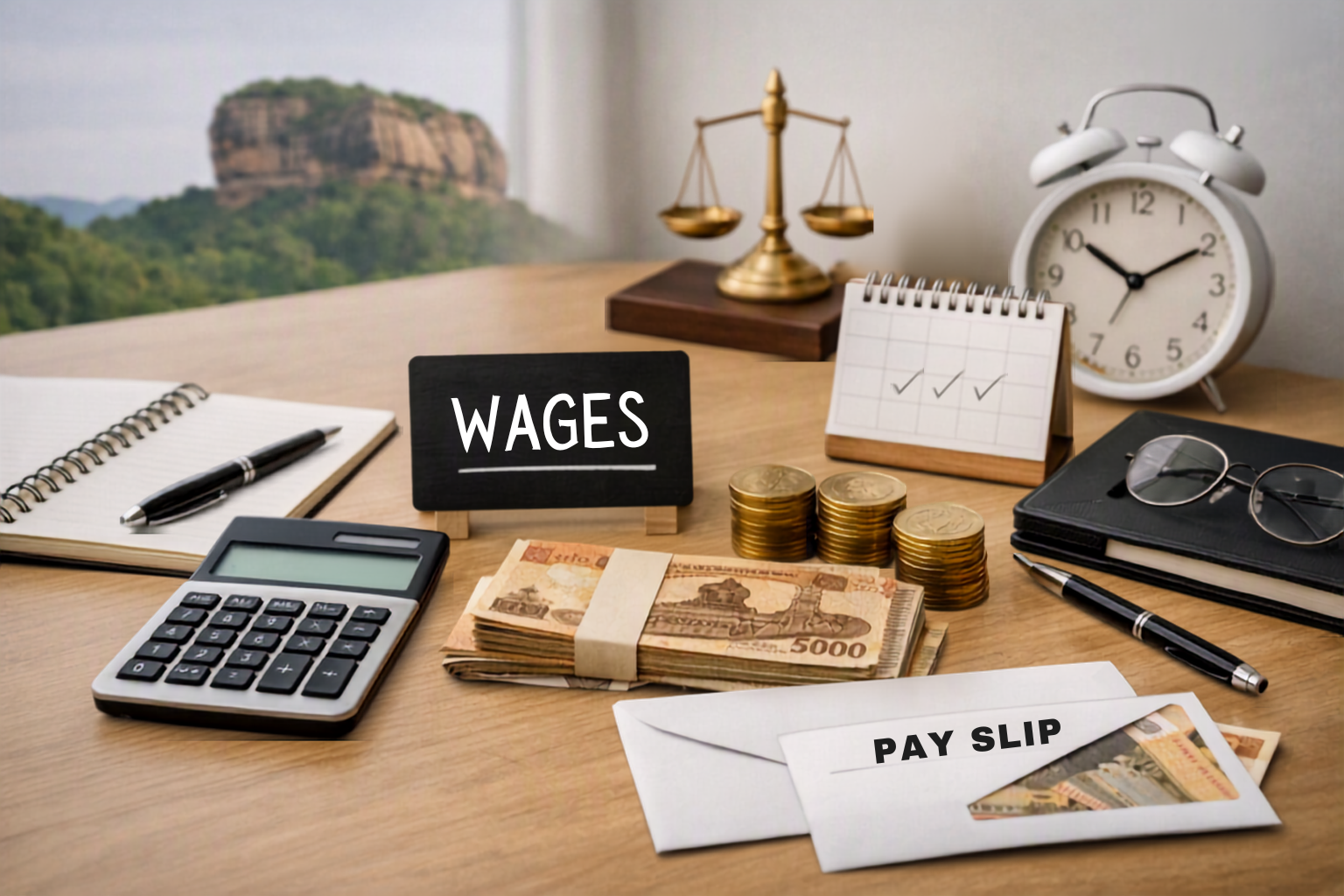
If you’re budgeting a Sri Lanka hire, the minimum wage itself is rarely the number that matters — most roles employers are actually filling (developers, support staff, finance, ops) sit well above it. But it’s still the statutory floor everything else is measured against, and it catches out foreign employers in two specific ways: assuming one national figure applies everywhere, and assuming the minimum wage is a meaningful proxy for market salary. This guide gives you the current figure, the legal basis behind it, where sector minima override it, and why it barely moves your real cost of hire.
The National Minimum Wage in Sri Lanka
As of 1 January 2026, Sri Lanka’s national minimum wage is:
- LKR 30,000 per month
- LKR 1,200 per day
This is set under the National Minimum Wage of Workers (Amendment) Act, No. 11 of 2025, which amended the original National Minimum Wage of Workers Act, No. 3 of 2016. The increase took effect from LKR 27,000/month and LKR 1,080/day, which had applied since 1 April 2025 — itself an increase from the previous structure of a LKR 16,000 base plus a separate Budgetary Relief Allowance. From April 2025, that allowance was consolidated into the base wage rather than paid as a separate line item.
For context on where this figure sits over time: the national minimum wage has risen from LKR 10,000/month in 2016 to LKR 30,000/month in 2026 — a threefold increase over a decade that includes Sri Lanka’s 2022 economic crisis and subsequent currency depreciation.
This floor applies to full-time private-sector employees across all industries, citizens and foreign workers alike, unless a higher rate has been set for their specific trade — which is common enough that foreign employers should never treat LKR 30,000 as a safe assumption without checking.
The Legal Basis
Sri Lanka’s wage-setting system operates on two layers, and both matter for compliance:
- The National Minimum Wage of Workers Act, No. 3 of 2016 (as amended by Act No. 11 of 2025) sets the single statutory floor described above, applicable across all private-sector employment regardless of trade.
- The Wages Boards Ordinance (Chapter 141) established a tripartite system of over 40 sector-specific Wages Boards, each with government, employer, and worker representation, empowered to fix minimum rates — for time work and piece work — for their specific trade.
Where a Wages Board has set a rate for a given trade, that rate applies instead of the national floor, but only if it’s higher. The national minimum acts as a backstop for workers in sectors without an active Wages Board, or where a board’s rate has fallen behind; it never allows an employer to pay below a valid, higher sector rate.
Sector Wages Boards
This is the part of the system that most often surprises a foreign employer setting up their first Sri Lankan payroll: the national figure is a floor, not a universal rate. Wages Boards exist for dozens of trades — including tea, rubber, coconut, garments and apparel, hotels, and security services — and several set rates meaningfully above LKR 30,000/month.
Two sectors worth knowing specifically:
- Tea and plantation workers. In January 2026, the government and regional plantation companies agreed a landmark increase for estate workers: the basic daily wage rose from LKR 1,350 to LKR 1,550, with an additional LKR 200 daily attendance allowance, bringing total daily earnings to LKR 1,750 — well above the national daily minimum.
- Apparel and garments. The sector’s roughly 360,000 workers are covered by a dedicated Wages Board, and while the national LKR 30,000 floor applies as a baseline, actual take-home pay — once attendance and productivity allowances required under sector agreements are included — commonly lands in the LKR 35,000–45,000 range.
Hotel and tourism workers are a related case: base pay tracks the statutory minimum, but earnings are typically boosted substantially by the mandatory 10% service charge distributed to staff, which sits outside the formal wage calculation entirely.
The practical takeaway: before setting a wage floor for any role tied to a specific trade — manufacturing, hospitality, security, agriculture — check whether that trade has an active Wages Board rate, rather than defaulting to the national figure.
Minimum Wage vs Living Wage
The statutory minimum and a living wage are different measurements, and the gap between them in Sri Lanka is large enough to matter for talent strategy, not just compliance.
The Anker Research Institute’s most recent reference value (June 2025) puts the gross living wage for urban Sri Lanka at LKR 115,291 per month — comprising a net living wage of LKR 106,068 plus a social security contribution of LKR 9,223. That figure reflects roughly 37% cumulative inflation between April 2022 and June 2025, and represents the income needed for a typical family to afford a basic but decent standard of living, not a subsistence minimum.
Set against the LKR 30,000 statutory floor, that’s nearly a fourfold gap. Put differently: paying the legal minimum wage in urban Sri Lanka covers roughly a quarter of what independent researchers estimate a worker actually needs. For the tea estate sector specifically, the equivalent living wage benchmark is lower in absolute terms (around LKR 48,584/month) but plantation earnings — even after the January 2026 increase — still sit meaningfully below it.
This isn’t an argument for or against any particular wage policy — it’s context. If you’re setting pay for entry-level or support roles, benchmarking against the statutory minimum alone will put you well below what’s needed to attract and retain staff in most of Sri Lanka’s formal labour market, urban roles in particular.
How Minimum Wage Interacts with Holiday Pay & Overtime
A few standard rules apply on top of whichever wage floor (national or sector) governs a role:
- Overtime is paid at 1.5 times the normal hourly rate.
- Work on Sundays and public holidays is paid at a premium — either 1.5 times the daily rate, or double the normal rate of remuneration, depending on the circumstances.
- Where pay is set weekly, the monthly-equivalent wage is calculated as 4.33 times the weekly rate; where pay is set hourly, the same 4.33 multiplier applies to standard weekly hours to derive a monthly figure.
- Standard hours under the Shop and Office Employees Act are capped at 8 hours/day and 45 hours/week for commercial establishments, with similar limits under the Factories Ordinance for industrial workers.
These multipliers apply on top of whatever base wage governs the role — national floor or Wages Board rate, whichever is higher. For the fuller mechanics of statutory leave, public holidays, and how they’re costed into a payroll run, see the Employment Law guide.
What This Means for Foreign Employers
For almost every role a foreign employer is actually hiring for in Sri Lanka — software developers, accountants, customer support, operations — the minimum wage is not the relevant benchmark. It matters for three narrower reasons:
- It’s the absolute legal floor, and paying below it (national or sector-specific) is a compliance breach regardless of contract terms.
- It’s the number some market-data widgets and payroll tools default to, which can understate what you actually need to budget if you’re not cross-checking against real market salary data for the role.
- It has no bearing on your real cost of employment. Even at the statutory floor, an employer is also carrying EPF at 12%, ETF at 3%, and statutory gratuity accrual (for employees who reach five years of service) on top of base wage — the same structure that applies at every salary level. The minimum wage tells you the legal floor for gross pay; it tells you nothing about total cost of employment.
For actual market benchmarks by role, see the Average Salary in Sri Lanka guide, and for the full build-out of gross salary plus EPF, ETF, gratuity accrual, and other statutory costs into a true monthly cost figure, see the True Cost of Hiring in Sri Lanka guide.
FAQ
What is the minimum wage in Sri Lanka in 2026?
As of 1 January 2026, Sri Lanka’s national minimum wage is LKR 30,000 per month, or LKR 1,200 per day, under the National Minimum Wage of Workers (Amendment) Act, No. 11 of 2025.
Is the minimum wage the same across all sectors in Sri Lanka?
No. The national figure is a floor. Over 40 sector-specific Wages Boards, established under the Wages Boards Ordinance, can set higher minimum rates for their trade — tea, rubber, garments, hotels, and security services among them — and those rates apply instead of the national floor where they’re higher.
How does Sri Lanka’s minimum wage compare to a living wage?
The Anker Research Institute’s June 2025 reference value put the gross living wage for urban Sri Lanka at LKR 115,291/month — nearly four times the LKR 30,000 statutory minimum, reflecting the cost of a basic but decent standard of living rather than a legal floor.
Does the minimum wage apply to foreign workers in Sri Lanka?
Yes. The statutory minimum wage applies to all workers employed in Sri Lanka, citizens and foreign nationals alike, across contract and permanent staff.
What is the real cost of hiring at the minimum wage in Sri Lanka?
Base wage is only part of the cost. Employers also pay EPF at 12% and ETF at 3% of gross wages, plus gratuity accrual for employees who complete five years of service — meaning actual cost of employment runs well above the gross wage figure even at the statutory floor.
How is overtime and holiday pay calculated on top of the minimum wage?
Overtime is paid at 1.5 times the normal hourly rate. Work on Sundays and public holidays is paid at 1.5 to 2 times the standard rate, depending on the circumstances, applied on top of whichever wage floor — national or sector — governs the role.
Comments